If you're a man over 40 making more nighttime trips to the bathroom
than you used to, the answer might not be in your medicine cabinet —
it might be in your kitchen.
TextBy Mark Reynolds | Independent Health Researcher | Updated [05/01/2026] | 8 min read

If you're a man over 40 who finds himself making more nighttime trips
to the bathroom than you used to — three, four, sometimes five times
a night — what I'm about to share with you might frustrate you.
But it could also be the most important 8 minutes you spend on your
health this month.Over the past two years, I've spent more than 200 hours reviewing
peer-reviewed research from organizations like the World Health
Organization, the NIH, and major European medical journals. I was
looking for an answer to a question my own father kept asking me:"Why does my prostate keep getting worse, no matter what my doctor does?"What I discovered shocked me. And it's not what most American urologists
are telling their patients.
Here's the uncomfortable truth: most prostate problems in American men
aren't caused by aging alone. They're being silently fueled by foods
we eat several times a week — foods that have been linked in major
studies to inflammation, hormonal disruption, and progressive prostate
damage.If you're like the men I've talked to during my research, you've
probably been told some version of this story by your doctor:"It happens to most men your age. Just take this medication and
manage the symptoms."But there are three specific foods that, according to the research,
may be making your prostate inflammation worse with every meal — and
they're sitting in most American kitchens right now.Let me walk you through what I found.
🥩 Food #1: Processed Meats (The Hidden Nitrite Problem)This was the first finding that stopped me cold.A landmark 2022 study from the NutriNet-Santé research project — one
of the most respected nutritional epidemiology programs in Europe —
tracked over 101,000 adults and found that men with the highest intake
of added nitrites (the preservatives in processed meats like hot dogs,
bacon, deli ham, and sausages) had a measurably elevated risk of
prostate problems compared to those with low intake.But here's what really concerned me: the World Health Organization's
International Agency for Research on Cancer (IARC) has classified
processed meat as a Group 1 carcinogen. That's the same category as
tobacco and asbestos.Most American men eat processed meat at least 3 times a week — often
not realizing they're doing so. A breakfast bacon. A lunchtime ham
sandwich. A weekend hot dog at the game.The mechanism isn't complicated. The nitrites used to preserve these
meats interact with proteins during digestion to form compounds called
N-nitroso compounds, which research has linked to inflammation
throughout the urinary system.What I started telling my father: if it comes from a package and has
"nitrite" or "nitrate" in the ingredients, treat it like tobacco.
Have it occasionally if you must, but don't make it a daily staple.

🥛 Food #2: Heavy Dairy (The IGF-1 Surprise)This one surprised me, because dairy has always been marketed as
"healthy" in America.A 2022 meta-analysis published in the British Journal of Nutrition
reviewed 32 separate studies on dairy and prostate health. The finding:
men consuming approximately 400 grams of dairy daily — that's about
two glasses of milk plus a serving of cheese — showed measurable
increases in prostate-related issues compared to lower-dairy consumers.Why? It comes down to a hormone called Insulin-like Growth Factor 1,
or IGF-1.Dairy products naturally spike IGF-1 levels in the bloodstream. While
IGF-1 is necessary for normal cellular growth, elevated levels have
been linked in research to accelerated prostate cell proliferation.
In other words: more milk and cheese means more growth signal sent
to your prostate cells.This doesn't mean you have to eliminate dairy completely. But if
you're a man over 40 who drinks milk daily, eats yogurt every
morning, and has cheese on multiple meals — your prostate is
receiving a constant stream of growth-stimulating hormones.What I tell men in this situation: cut your dairy intake roughly
in half. Switch to plant-based alternatives for one or two of your
daily servings. Within a few weeks, many men report noticeable
improvements in urinary symptoms.

🔥 Food #3: Charred Grilled Meats (The HCA Problem)I almost didn't believe this one when I first read the research.The NIH-AARP Diet and Health Study — one of the largest dietary
cohort studies ever conducted in the United States, tracking
175,343 men for nearly a decade — found a significant association
between consumption of well-done, charred, or barbecued meats and
advanced prostate concerns.The culprit? Compounds called heterocyclic amines (HCAs) and
polycyclic aromatic hydrocarbons (PAHs). When meat is cooked at
high temperatures — especially over an open flame, until it's
charred or well-done — these compounds form on the surface of the
meat. The blacker and crispier the meat looks, the more of these
compounds are present.For American men who love a good barbecue, this is hard news.But it doesn't mean you have to give up grilled meat forever. The
research suggests:- Cook to medium, not well-done
- Trim charred portions before eating
- Marinate meat before grilling (marinades reduce HCA formation
by up to 87% according to some studies)
- Use lower-temperature cooking methods (sous vide, oven roasting)
for everyday meals
- Save the BBQ for occasional treats, not weekly ritual

👉 The European doctors who developed the alternative approach
discussed this exact food connection in their 30-year clinical
research. You can see what they recommend instead here: https://f7387ngfw43dojzmwc8fzbdn6f.hop.clickbank.net/
But Avoiding These Foods Isn't Enough — Here's WhyHere's the part that took me longest to understand.Cutting processed meat, dairy, and charred grilled foods is a
critical first step. But for most men over 40 — especially those
already experiencing nighttime urination, weak flow, or that
constant feeling of "needing to go again" — diet alone usually
isn't enough.Why? Because by the time symptoms appear, the prostate is already
inflamed. Removing the trigger foods stops the damage from getting
worse, but doesn't help your prostate calm down and recover.This is where my research took an unexpected turn — toward Europe.

Why German, French, and Italian Doctors
Have Been 30 Years Ahead of the USIn Germany, France, and Italy, doctors have been prescribing a
completely different approach to prostate health for over three
decades. While American urologists default to prescription
medications with side effects (reduced libido, dizziness, the
list goes on), European urologists routinely recommend three
specific plant compounds first.These three plants aren't a "secret" or a "hidden cure." They're
documented in dozens of peer-reviewed clinical studies. They're
sold in European pharmacies. They've been used by millions of men.
And they all work through different but complementary mechanisms
to support prostate health.Here are the three:▪️ Saw Palmetto (Serenoa repens)
A small palm plant native to the southeastern United States.
Research published in the British Journal of Urology International
has shown that saw palmetto extract may help support healthy
urinary flow by reducing the conversion of testosterone to
dihydrotestosterone (DHT) — the form of testosterone associated
with prostate enlargement.▪️ Pygeum Africanum (African Plum Tree Bark)
For decades a first-line treatment in France for benign prostatic
hyperplasia (BPH). A 1991 clinical study published in Archivio
Italiano di Urologia showed that just 50mg of pygeum extract
taken twice daily was associated with significant improvements
in urinary flow and reductions in nighttime urination frequency.▪️ Beta-Sitosterol
A plant sterol naturally found in pumpkin seeds, walnuts, and
certain plant oils. A 1990 study in the British Journal of
Urology demonstrated that beta-sitosterol may help support
healthy urinary flow and reduce post-void residual urine —
the leftover urine that creates that "I still have to go"
feeling many men with prostate concerns experience.The challenge: getting these three compounds in the right
clinical-grade dosages, in the right combination, isn't easy.
You'd have to source them from three different specialty
suppliers and dose them precisely.Until recently.
The Formulation That Combines All Three (And Why It's Getting
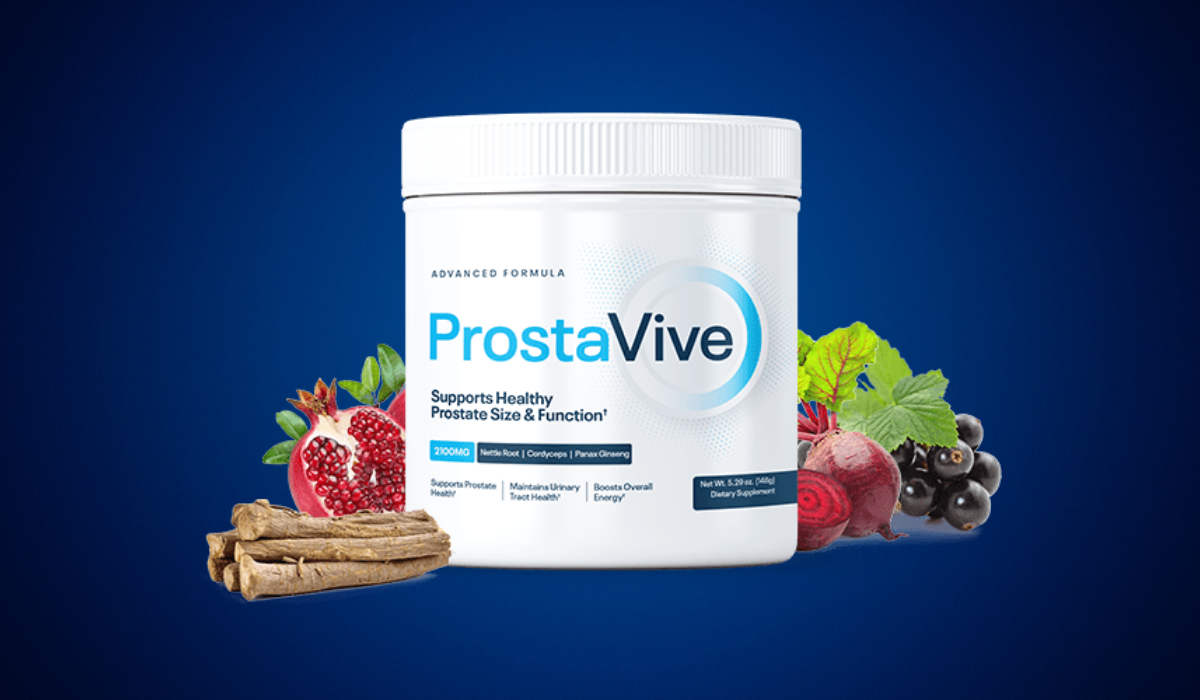
Attention From American Men)About six months into my research, I came across a natural
formulation called ProstaVive.I'll be honest — I was skeptical at first. The supplement industry
is full of overpromising products with under-delivering ingredients.
But what caught my attention was that ProstaVive doesn't try to
reinvent the wheel. It combines exactly the three compounds that
European doctors have been using for 30 years — saw palmetto,
pygeum bark, and beta-sitosterol — at the dosages clinical research
has identified as effective.Plus a few additional supportive ingredients (zinc, lycopene,
pumpkin seed extract) that are all backed by their own research
on male urinary and prostate health.What makes it different from most American prostate supplements:- It uses the same evidence-based ingredients European doctors
have prescribed for decades
- Manufactured in an FDA-registered facility in the United States
- Contains no nitrites, no artificial preservatives, no fillers
- Comes with a 90-day money-back guarantee — so men can try it
for the full duration recommended in clinical research before
making any long-term decision
- Single daily serving (no complicated dosing schedule)Is it the only option? No. You could buy saw palmetto, pygeum,
and beta-sitosterol separately and dose them yourself. But for
most men I've spoken with, the convenience of having all three
in clinical-grade doses in one daily serving is worth it.For full transparency: I receive a small commission if men
purchase ProstaVive through the link in this article. This is
standard practice for independent health publications and helps
me continue this research. It does not change my recommendation
or the research I've cited, all of which is publicly available
in the journals mentioned.
"Will This Actually Work For Me?" — What I Tell Men Who AskOver the past few months, I've had dozens of men message me with
the same questions. Here are the most common, and what I've found
in my research:"How long before I notice anything?"
The clinical research on these three plants typically shows
measurable improvements in urinary symptoms between 30-90 days
of consistent use. Some men report changes in nighttime frequency
within 2-3 weeks; for others, it takes the full 90 days. This is
why ProstaVive's 90-day guarantee is important — it lets you try
it for the full clinical research duration before deciding."What if it doesn't work?"
Then ProstaVive's policy is straightforward: contact their support
within 90 days for a full refund. No questions, no shipping back
the bottle. This is why I felt comfortable recommending this
specific brand — they don't make you take all the risk."Is this safe with my current medications?"
Saw palmetto, pygeum, and beta-sitosterol are some of the most
studied plant compounds in male health. They've been used by
millions of European men for over 30 years with an excellent
safety profile. That said, ALWAYS check with your doctor before
adding any supplement — especially if you take blood thinners or
prostate-specific medications."Why haven't I heard of this from my doctor?"
This was the question that frustrated me most during my research.
The honest answer: most American medical training emphasizes
pharmaceutical interventions, and most American doctors simply
aren't taught about plant-based approaches that have been
standard practice in European urology for decades. It's not a
conspiracy — it's just how medical training systems differ
between countries.

Where to Go From HereIf you've read this far, you probably recognize at least one of
the three foods I described as something you eat regularly.
That's actually good news — because it means there's something
specific you can change.Here's what I'd recommend, based on everything I've researched:1. Start cutting back on processed meats, heavy dairy, and
charred grilled foods. Even reducing them by half can make
a difference within a few weeks.2. Consider a clinical-grade combination of the three European
plant compounds — saw palmetto, pygeum, and beta-sitosterol
— to help support your prostate while diet changes take effect.3. Talk to your doctor about your symptoms. Not all prostate
issues are the same, and serious symptoms always deserve
medical evaluation.For men who want to skip the trial-and-error of buying three
separate supplements at the right dosages, ProstaVive is the
formulation I currently recommend.You can see their current pricing, ingredient transparency, and
90-day guarantee policy at the link below.
"Free shipping on multi-bottle orders · 90-day money-back guarantee · USA-based customer service"
─────────────────────────────────────────────DISCLOSURES & DISCLAIMERSAffiliate Disclosure: This article contains affiliate links. If
you purchase a product through one of these links, I may receive
a small commission at no additional cost to you. This does not
influence the research or recommendations in this article.Health Disclaimer: The information in this article is for
educational purposes only and is not intended as medical advice.
The statements made about specific products have not been
evaluated by the U.S. Food and Drug Administration. These
products are not intended to diagnose, treat, cure, or prevent
any disease. Always consult with a qualified healthcare provider
before starting any new supplement, especially if you have a
medical condition or take medication.Research Citations: All studies referenced in this article are
publicly available through PubMed and the journals cited. Specific
study identifiers can be provided upon request.Results May Vary: Individual results from supplements vary based
on genetics, lifestyle, diet, and other factors. The research
findings cited reflect study averages and do not guarantee
identical outcomes for any individual.© 2026 prostatecareresearch.com · [Privacy Policy] · [Terms of Service] · Contact